
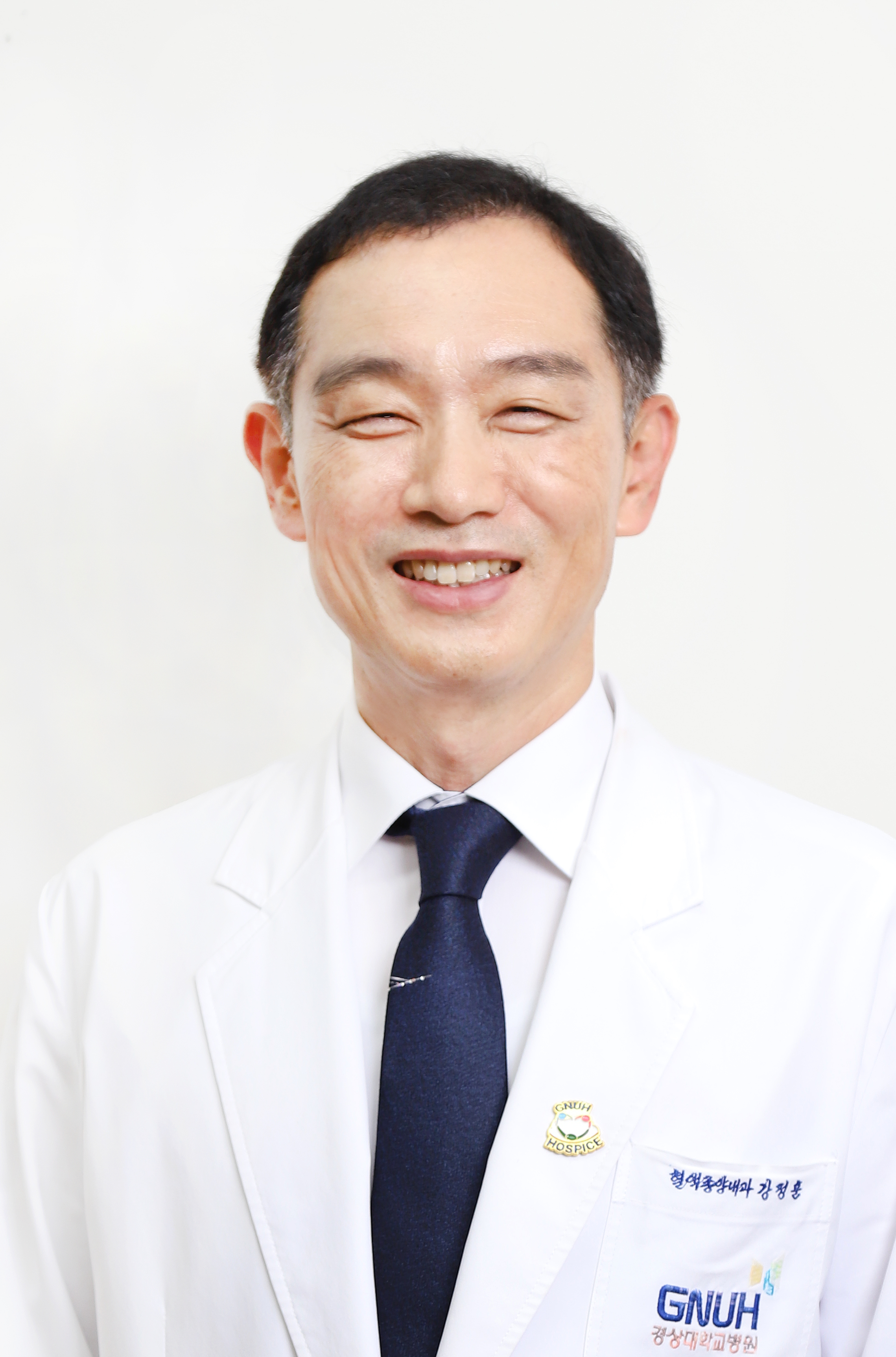
Kang Jeong-hun
Gyeongsang National University Hospital|Hematology and Oncology
Gyeongnam Jinju City
Last updated
Esophageal cancerStomach cancerColon cancer/rectal cancerLiver cancerPancreatic cancerBile duct cancer
Professor Kang Jeong-hun specializes in cancer care, including esophageal and gastric cancers, and provides systematic care through a cancer survivor clinic.
Medical opinions · Patient reviews0
No reviews yet.
If you've been treated by Kang Jeong-hun, be the first to leave a review.
Planning to see Kang Jeong-hun?
Save this doctor and find them again anytime on My page.
Ask other patients
If reviews don't answer your questions, ask patients and caregivers who have been there.
Patient stories: Hematology and Oncology
MoreHospital information
- Specialties
- More Hematology and Oncology doctors
- Address
- 79 Gangnam-ro, Jinju-si, Gyeongsangnam-do
- University
- 경상국립대학교 의과대학
- Appointments
- 055-750-8700Book by phone (055-750-8700)
Education and career
Education
- Graduated from Gyeongsang National University College of Medicine
Career
- Completed residency in Internal Medicine at Gyeongsang National University Hospital
- Fellowship in Hematology and Medical Oncology at Samsung Seoul Hospital
- Training in Palliative Care and Rehabilitation Medicine at The University of Texas MD Anderson Cancer Center
- Current: Professor of Hematology and Medical Oncology at Gyeongsang National University Hospital
- Current: Director of the Gyeongnam Regional Cancer Center
- Current: President of the Research Group for Cancer Palliative and Supportive Care of the Korean Society of Medical Oncology
- Current: Academic Director of the Korean Society for Hospice and Palliative Care
- Former: Chair of the Palliative Care Division of the Korean Association for Clinical Oncology
- Awards:
- Academic Award from the Gyeongsangnam-do Medical Association (2013)
- Grand Prize in the National Cancer Control Program (2014)
- Minister of Health and Welfare Award for Hospice-Related Contributions (2015)
- Publications and Books
- Major studies related to palliative care (2015–present)
- Dexamethasone-Induced Hiccups: An Important But Inconspicuous Symptom in Cancer.
- J Palliat Med. 2020 Nov;23(11):1421
- Interference with daily functioning by breakthrough pain in patients with cancer.
- Support Care Cancer. 2020 Nov;28(11):5177-5183
- A Randomized Controlled Trial of Epidermal Growth Factor Ointment for Treating Epidermal Growth Factor Receptor Inhibitor-Induced Skin Toxicities. Oncologist. 2020 Jan;25(1):e186-e193.
- Clinical Patterns of Continuous and Intermittent Palliative Sedation in Patients With Terminal Cancer: A Descriptive, Observational Study. J Pain Symptom Manage. 2019 Jul;58(1):65-71.
- Survey of Preferences and Compliance with Medical Intervention Items Among Hospice Ward Patients Through Analysis of the Modified Korean Physician Order for Life-Sustaining Treatment (MK-POLST). Korean J Hosp Palliat Care 2019 December;22(4):198-206
- Sedation for terminally ill cancer patients: A multicenter retrospective cohort study in South Korea. Medicine (Baltimore). 2019 Feb;98(5):e14278.
- Compassion is a key quality for palliative care teams. Cancer medicine, 2018, 7(11): 5325-5326.
- Craving Behavior from Opioid Addiction Controlled with Olanzapine in an Advanced Cancer Patient: A Case Report. J Palliat Med. 2018 Sep;21(9):1367-1370.
- Successful Treatment with Transdermal Buprenorphine Patch in Opioid-Dependent Cancer Patients: Case Series. Korean J Hosp Palliat Care 2018; 21(4): 152-157
- Antiemetic Corticosteroid Rotation from Dexamethasone to Methylprednisolone to Prevent Dexamethasone-Induced Hiccup in Cancer Patients Treated with Chemotherapy: A Randomized, Single-Blind, Crossover Phase III Trial. Oncologist. 2017 Nov;22(11):1354-1361
- Opioid Withdrawal Symptoms after Conversion to Oral Oxycodone/Naloxone in Advanced Cancer Patients Receiving Strong Opioids. Korean J Hosp Palliat Care 2017; 20(2): 131-135
- Qualitative Study on the Perceptions of Terminally Ill Cancer Patients and Their Family Members Regarding End-of-Life Experiences Focusing on Palliative Sedation. J Pain Symptom Manage. 2017 Jun;53(6):1010-1016
- Intravenous Oxycodone versus Intravenous Morphine in Cancer Pain: A Randomized, Open-Label, Parallel-Group, Active-Control Study. Pain Res Manag. 2017;2017:9741729.
- Gender Differences in Hiccup Patients: Analysis of Published Case Reports and Case-Control Studies. J Pain Symptom Manage. 2016 Feb;51(2):278-83.
- Non-Steroid Anti-Inflammatory Agents for Management of Cold Sweating in Advanced Cancer Patients. Korean J Hosp Palliat Care 2016; 19(4): 331-334
- Phase II trial of epidermal growth factor ointment for patients with Erlotinib-related skin effects. Support Care Cancer. 2016 Jan;24(1):301-9.
- Hiccups during Chemotherapy: What Should We Do? J Palliat Med. 2015 Jul;18(7):572
- The efficacy of low-dose transdermal fentanyl in opioid-naïve cancer patients with moderate-to-severe pain. Korean J Intern Med. 2015 Jan;30(1):88-95.
- Gang Jeong-hun, Kim Si-yeong. Opioid analgesics in pain management. Textbook of Hospice and Palliative Care. 2018. Gunja Publishing.
- Studies related to pancreatic and biliary tract cancers (2015–present)
- Capecitabine Plus Oxaliplatin Versus Gemcitabine Plus Oxaliplatin as First-Line Therapy for Advanced Biliary Tract Cancers: A Multicenter, Open-Label, Randomized, Phase Three, Non-Inferiority Trial. Ann Oncol. 2019 Feb 20.
- Attenuated FOLFIRINOX in the salvage treatment of gemcitabine-refractory advanced pancreatic cancer: a phase II study. Cancer Commun (Lond). 2018 Jun 4;38(1):32.
- Chemotherapy versus Best Supportive Care in Advanced Biliary Tract Carcinoma: A Multi-institutional Propensity Score Matching Analysis. Cancer Res Treat. 2018 Jul;50(3):791-800.
- Is There a Role for Adjuvant Therapy in R0 Resected Gallbladder Cancer?: A Propensity Score-Matched Analysis. Cancer Res Treat. 2016 Oct;48(4):1274-1285.
Academic societies
- Korean Association of Internal Medicine
- Korean Society of Medical Oncology
- Korean Society for Hospice and Palliative Care
- Korean Cancer Association
- Multinational Association of Supportive Care in Cancer (MASCC)
- European Society for Medical Oncology
FAQ
- What conditions does Kang Jeong-hun treat?
- Kang Jeong-hun (Hematology and Oncology, Gyeongsang National University Hospital) treats conditions such as Esophageal cancer, Stomach cancer, Colon cancer/rectal cancer, Liver cancer, Pancreatic cancer, Bile duct cancer.
- Where does Kang Jeong-hun see patients?
- In Hematology and Oncology at Gyeongsang National University Hospital. The hospital address is 79 Gangnam-ro, Jinju-si, Gyeongsangnam-do.
- What is Kang Jeong-hun's specialty?
- Specialty: Hematology and Oncology.
Is any information wrong?
Let us know about changes to hospital, specialty, career and so on, and we'll update it after checking.